
Why a Wedding Planning Checklist Works
A wedding isn't one big job. It's a few hundred small ones — the venue deposit, the guest list that won't stop changing, the caterer who needs a headcount, the playlist, the seating chart, the thank-you notes. Held in your head all at once, it feels enormous. Written down and broken into tasks, it becomes a list you can actually work through.
That's the whole trick, and it's backed by more than good intentions. Here's why a wedding planning checklist works, and how to build one you'll actually follow.
Key Takeaways
- Wedding planning overwhelm comes from volume, not difficulty — dozens of small decisions competing for attention at once.
- Writing a task down as a concrete plan measurably quiets the mental "nagging," according to research from the Journal of Personality and Social Psychology (Masicampo & Baumeister, 2011).
- Break big items into small next actions, group them by phase, and give each one an owner and a date. Start with the timeline below.
Why wedding planning feels so overwhelming
The problem usually isn't any single task. It's the pile.
In Zola's 2024 First Look Report, a survey of nearly 7,000 couples, the biggest planning pain points were creating and managing the budget, followed by the guest list and booking vendors — and 44% of couples said they dealt with family drama along the way (Zola First Look Report, 2024). Stack that on top of an average of 117 guests per US wedding (The Knot 2026 Real Weddings Study), and you've got a lot of moving parts to keep straight.
None of it is hard on its own. Booking a photographer is a phone call. The trouble is that you're tracking forty of those phone calls at once, in your head, while also living your life. That mental juggling is the real source of the stress — and it's exactly what a task list is built to fix.
What writing tasks down actually does to your brain
A checklist doesn't just remember things for you. It quiets them.
Psychologists Masicampo and Baumeister found that unfinished goals keep interrupting us — intruding on unrelated thoughts and pulling at our attention until they're dealt with. But their studies showed something useful: simply making a specific, concrete plan for an unfinished task removed that mental interference almost as well as actually completing it (Journal of Personality and Social Psychology, 2011). The nagging stops once your brain trusts there's a plan.
That's why "book the florist" rattling around your mind at 2 a.m. feels heavier than the same words sitting on a checklist with a date next to them. On the list, your brain lets it go. In your head, it keeps knocking. For a project as long and emotionally loaded as a wedding — often a year or more of planning — that relief compounds week after week.
How to break wedding planning into tasks
The skill isn't making a list. It's breaking big, vague items into small, do-able ones. Five moves:
- Brain-dump everything. Get every worry, idea, and to-do out of your head and onto one page. Don't organize yet — just empty the tank.
- Split the big rocks into next actions. "Book the venue" isn't a task, it's a project. The tasks are: shortlist five venues, email for availability, book two tours, compare quotes, pay the deposit. Each one is a single, clear step.
- Group by phase. Sort everything into rough time buckets (see the timeline below) so you're never staring at all of it at once.
- Give every task an owner. "Us" is where tasks go to die. Put a name next to each — yours, your partner's, a parent's, the planner's.
- Add a date. Not a perfect date. Just a "by when," so the list tells you what's next instead of you deciding it forty times a day.
A simple wedding planning timeline to start from
You don't need to invent the structure from scratch. Use these phases as a skeleton and pour your brain-dump into them:
| Phase | Focus | Example tasks |
|---|---|---|
| 12+ months out | The big rocks | Set the budget, draft the guest list, book the venue and date |
| 6–9 months | Vendors | Book photographer, caterer, and band or DJ; send save-the-dates |
| 2–3 months | Details | Finalize the menu, order attire, send invites, plan the photo gallery |
| Final month | Logistics | Confirm the headcount, print signage, build the day-of timeline |
| Week of | Hand-off | Delegate day-of jobs, brief your MC, and let the list run the show |
The point of the phases isn't rigidity — it's permission to ignore the week-of tasks while you're twelve months out. Future-you will get the reminder when it matters.
Don't forget the photos
One task that's easy to leave off every checklist: deciding how you'll actually collect photos from your guests. It's the kind of thing nobody thinks about until the week after the wedding, when the best candid shots are still trapped on two hundred phones.
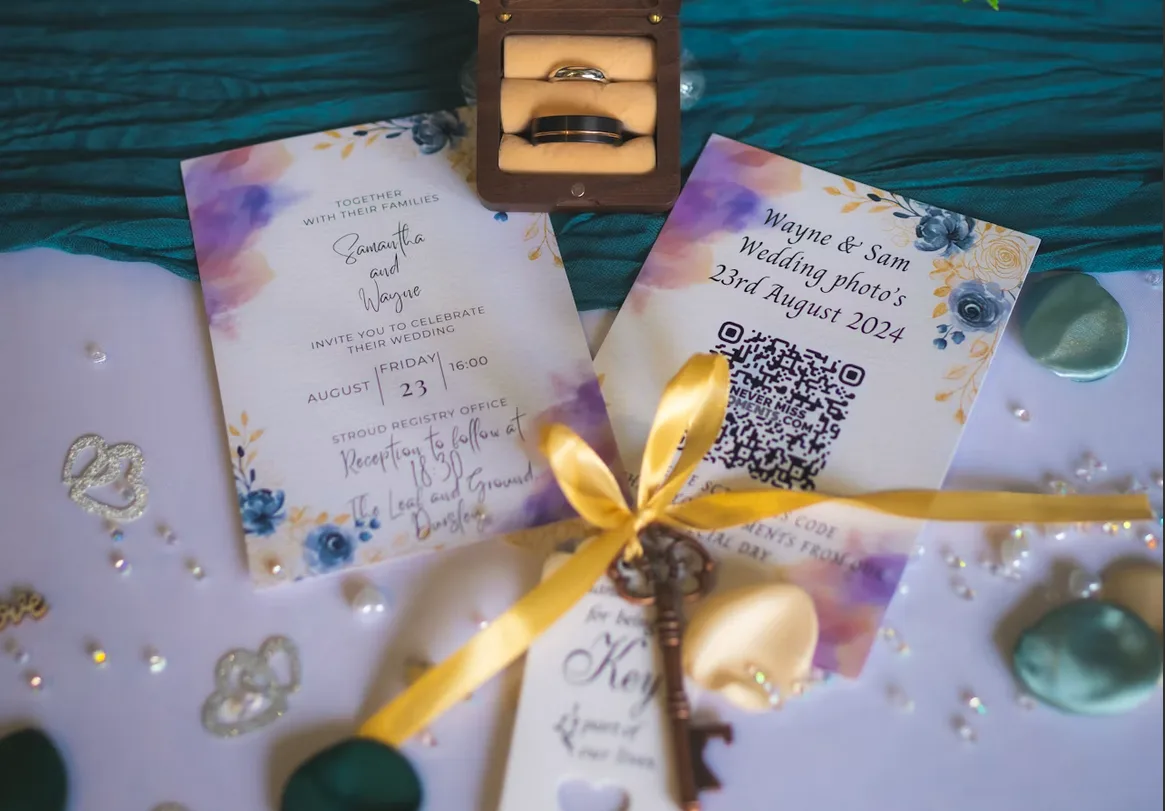
Add it to the "2–3 months" phase and it takes ten minutes: set up a shared gallery and a QR code guests can scan on the day. If you want the details, we've written the full walkthrough on how to collect wedding photos from guests, plus five ways to get your guests to actually share their photos. It's one more task off your head — and onto a list that handles it for you.
Frequently asked questions
When should I start my wedding planning checklist?
The day you set a date, or even before. Starting early doesn't mean doing everything early — it means the far-off tasks are captured and parked so they stop nagging you. Most couples plan over roughly a year, so an early list mostly sits quiet until each phase comes due.
Should my checklist be digital or on paper?
Whichever you'll actually open. Paper is satisfying to cross off; a shared digital list lets you and your partner both add and check items from anywhere, which matters when the tasks are genuinely split between two people. The worst checklist is the one you made once and never looked at again.
How detailed should each task be?
Detailed enough that you know the exact next step without thinking. "Sort the flowers" is a project; "email three florists for quotes" is a task. If an item makes you hesitate about what to actually do, it's too big — break it down one more level.
How do we split the tasks between partners?
Assign an owner to every item rather than sharing everything vaguely. Play to strengths and interests, then check in weekly for ten minutes. Clear ownership prevents both the "I thought you were doing that" gaps and the resentment that builds when one person quietly carries the whole list.
Bring it all together
Wedding planning feels overwhelming because you're holding a few hundred decisions in your head at once. A checklist doesn't make the work smaller — it makes it visible, ordered, and quiet. Break the big items into next actions, drop them into a timeline, give each one an owner and a date, and let the list do the remembering so you can enjoy the year leading up to your day.
Start with a photo-sharing task you can knock out in minutes: create your event gallery now and it'll be ready long before the first guest arrives.